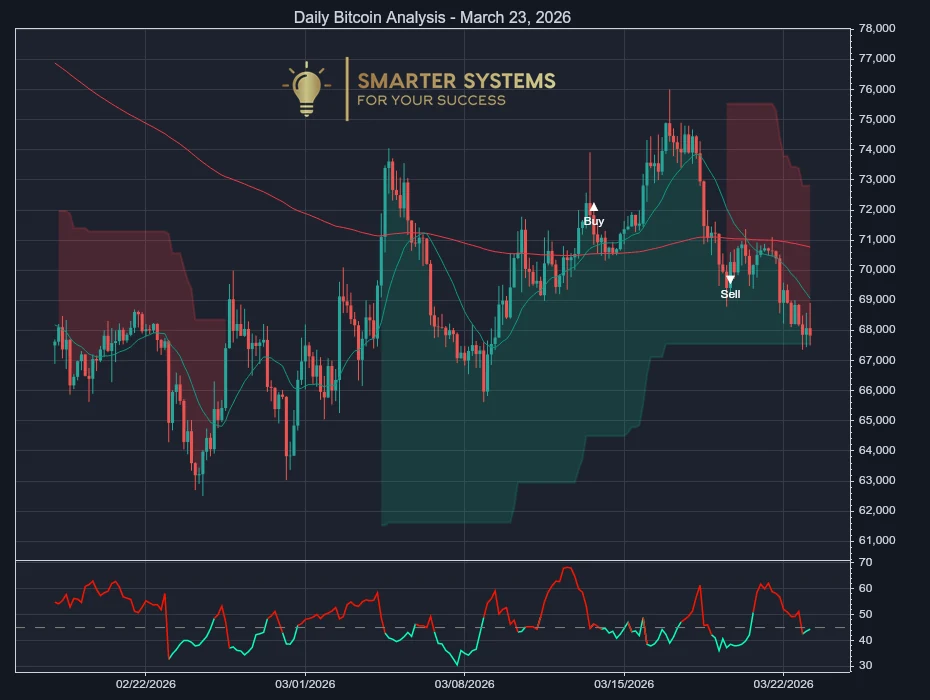
// previous briefing Daily Bitcoin Analysis - March 23, 2026
Bitcoin Market Read for March 24, 2026
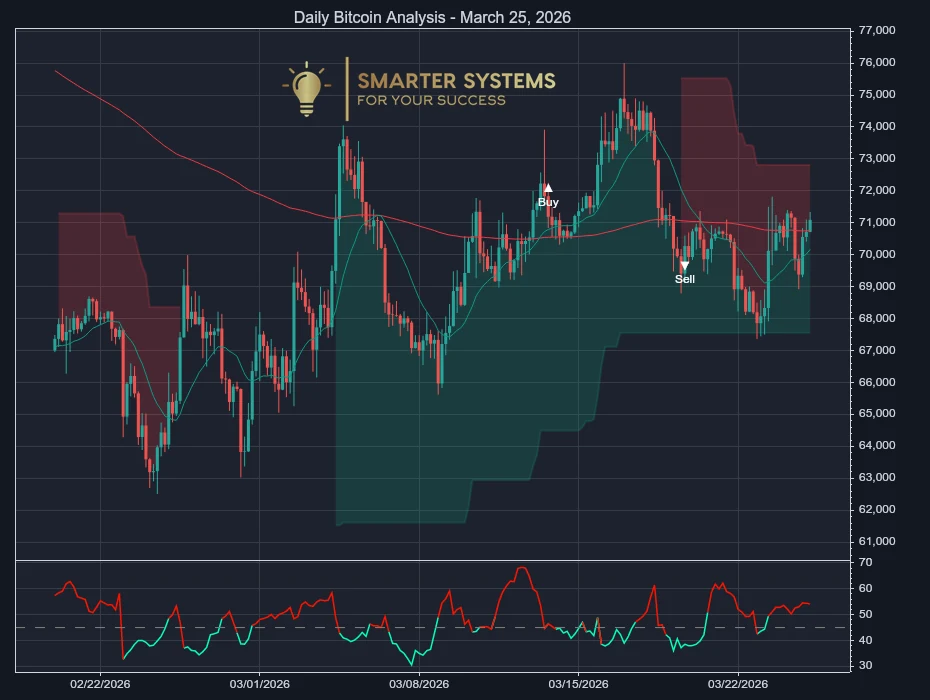
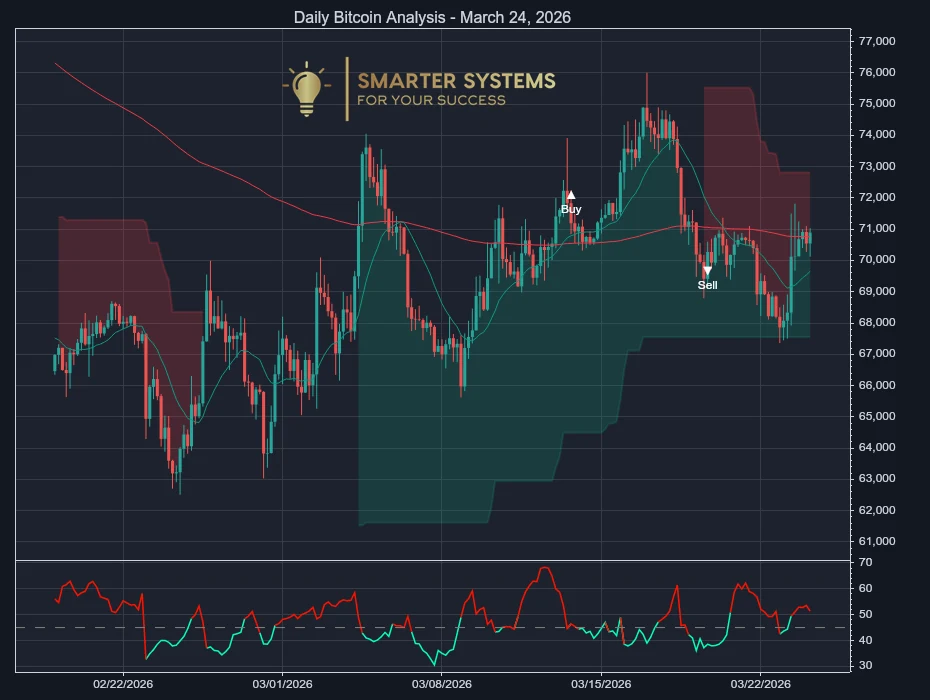
Bitcoin is trading at 70892.9, and the striking feature of the latest move is not weakness on its own but how little clean follow-through either side has managed to produce. Price pushed higher earlier in the sequence, held close to those gains for a time, then slipped, then recovered again, yet none of these swings has carried the kind of conviction that would usually settle the argument. That creates tension. On the surface Bitcoin still looks active, but underneath that activity there is hesitation. Buyers are still present, though not in a way that fully takes control, while sellers keep leaning into strength enough to slow the advance and keep the market from opening up to the upside.
The current condition is best understood as a market trying to stabilise after a sharp stretch, but doing so without real ease. Bitcoin is moving, but it is not moving freely. Every lift has met supply quickly enough to interrupt momentum, and every dip has found enough demand to prevent a full unwind. That leaves price in a state where participation remains real, yet conviction remains limited. For investors, this is the kind of tape that asks for close attention to how price behaves rather than broad assumptions. Bitcoin is not collapsing, but it is also not yet behaving like a market ready to trend cleanly higher from here.
Looking only at the progression from one period to the next, the market first expanded aggressively, then lost pace. The earlier advance came with a broader swing and stronger activity, which told us capital was willing to engage decisively. After that, the upward progress became narrower and volume thinned materially. That matters. When Bitcoin continues to edge up while the underlying participation fades, the move starts to look less like a strong campaign by buyers and more like a market drifting higher on reduced resistance. The following pullback then arrived with a somewhat wider move and a pick-up in activity, which suggested sellers were still willing to press when price sat higher. The latest recovery has improved the close again, but the range has not meaningfully expanded and participation, while better than in the quietest stretch, has not returned to the force seen earlier. In practical terms, Bitcoin has spent the last few periods shifting from an impulsive rise into a more hesitant back-and-forth, where the quality of buying pressure has become less convincing than the headline price alone might suggest.
Viewed in that wider structural light, Bitcoin still carries the footprint of a market where rallies are not yet escaping overhead pressure. The path of least resistance has not turned decisively upward. Instead, price is still behaving as though sellers remain comfortable meeting strength, and buyers are having to work harder to defend levels than they are to extend gains. At the same time, the action itself has not been especially clean. Rather than a smooth sequence of one side steadily asserting control, Bitcoin is trading with interruptions, reversals, and pauses that show an ongoing tug of war. That kind of movement does not mean the market is directionless in an absolute sense, but it does mean that acting on every push becomes difficult because the follow-through keeps arriving in fragments rather than in a continuous move.
Against that backdrop, this looks like a point where taking money off the table could be the more sensible course than pressing for more upside. Bitcoin has recovered from the latest dip, but the recovery does not yet carry the kind of broad support that would argue for aggressive fresh exposure. When a market rises with less participation than before and remains prone to interruption, it often pays to respect what the tape is saying rather than what traders hope it will become. That does not require a bearish grand statement on Bitcoin. It simply means the recent action favours restraint, especially after strength, because the market has not shown enough evidence that buyers can sustain pressure once price starts to lift.
Markets in this phase often keep frustrating both sides before they reveal the next cleaner move. Bitcoin can continue to oscillate, recover, and slip again without changing the bigger message that conviction is still thin. The practical insight here is simple: when price keeps revisiting the same area after an advance, investors should pay less attention to each short-term bounce and more attention to whether buying pressure is actually broadening or fading. In Bitcoin, repeated rebounds can look constructive at first, but if they arrive with only modest expansion in activity and little improvement in follow-through, they tend to mark absorption rather than fresh leadership. That is usually a sign to stay selective, protect recent gains, and wait for the market to show where capital is genuinely prepared to commit.
// disclaimer This briefing is educational market commentary from a rule-based system. It is not financial advice and not a personal recommendation. Cryptocurrency is highly volatile, and past signals do not guarantee future results. Only invest money you can afford to lose. Read the full disclaimer.